Turning a public
glance into a
safe digital signal.
A survey-led requirement testing study — concept testing, feature-priority analysis and A/B design comparison — used to validate whether Glance is useful, safe and acceptable before a single screen was built.
People notice each
other in public — but
the moment often
disappears.
Many young adults hesitate to connect with someone they notice in public. The interaction can feel risky — the person may not be interested, the moment may become awkward, or the approach may be misread. Directly searching for a stranger on social media usually isn't possible either, since their name or profile is unknown.
The problem is not only communication — it's trust. A nearby-discovery app can easily feel unsafe if people worry about being watched, tracked, or contacted without consent.
Core Research Question
Can a proximity-based social discovery app become acceptable if it protects identity through anonymous vibes and mutual consent?
Where the moment happens
Intended usage context
Flow tested
Become visible in a nearby space → send an anonymous vibe → the other person can send one back → only mutual interest unlocks profiles → a safer conversation begins. No past-location tracking, ever.
A mixed-evidence approach, tested on the audience Glance is built for.
Survey Questionnaire
Main method — Likert scales, feature ratings and multiple-choice questions.
Concept Testing
Clarity, usefulness, trust and trial intention for the Glance idea itself.
A/B Design Testing
Design A (direct discovery) vs Design B (privacy-first) on safety, clarity and preference.
Qualitative Feedback
Open-ended responses manually coded into recurring themes.
Respondent Profile
15 valid responses — mostly university students in the first target segment.
A small, early-stage pilot sample. It is not full market proof, but it is directly relevant for validating an early university-oriented use case.
Aged 22–25
University students
Daily+ social media use
Never used a dating/discovery app
The problem is real —
and it isn't about
finding people.
Privacy concern scored highest of all statements tested (mean 4.20, 86.7% agreement). The core problem isn't discovery — it's making the first step feel safe, private and emotionally low-risk. Requirement implication: privacy and consent must be designed before discovery mechanics.
Mean agreement · scale 1–5
Mean agreement · scale 1–5
Users accept Glance
when trust is visible
in the concept.
Glance isn't judged only as a social app — respondents responded most strongly to differentiation, safety controls, and the no-tracking promise. The product narrative should lead with privacy and consent, not with discovery.
Reading this carefully
86.7% said they'd be interested in trying Glance — a strong early signal, but concept interest doesn't guarantee real usage from a 15-person pilot. It confirms the concept is worth prototyping, not that it's market-proven.
Build trust before adding intelligence.
Mean importance · scale 1–5
Top 3 Feature Selections
AI-generated conversation starters scored lowest across every measure (2.60 importance, only 1 top-3 vote). It moves out of the MVP and into a later release, once trust and safety are validated.
Design B wins trust. Design A wins clarity.
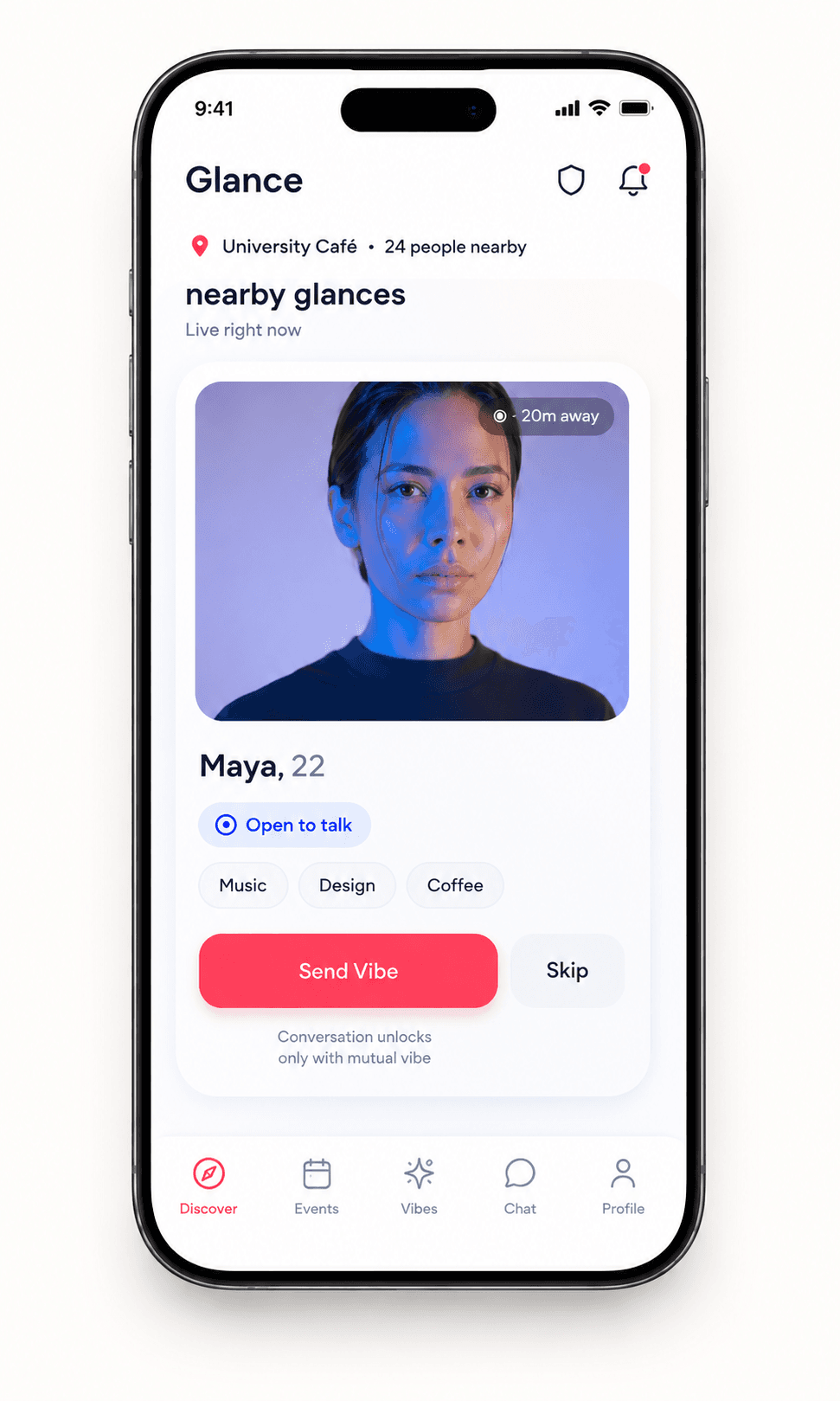
Direct Discovery Interface
Design A
Visible profile cards, images and distance — faster to read, less private.
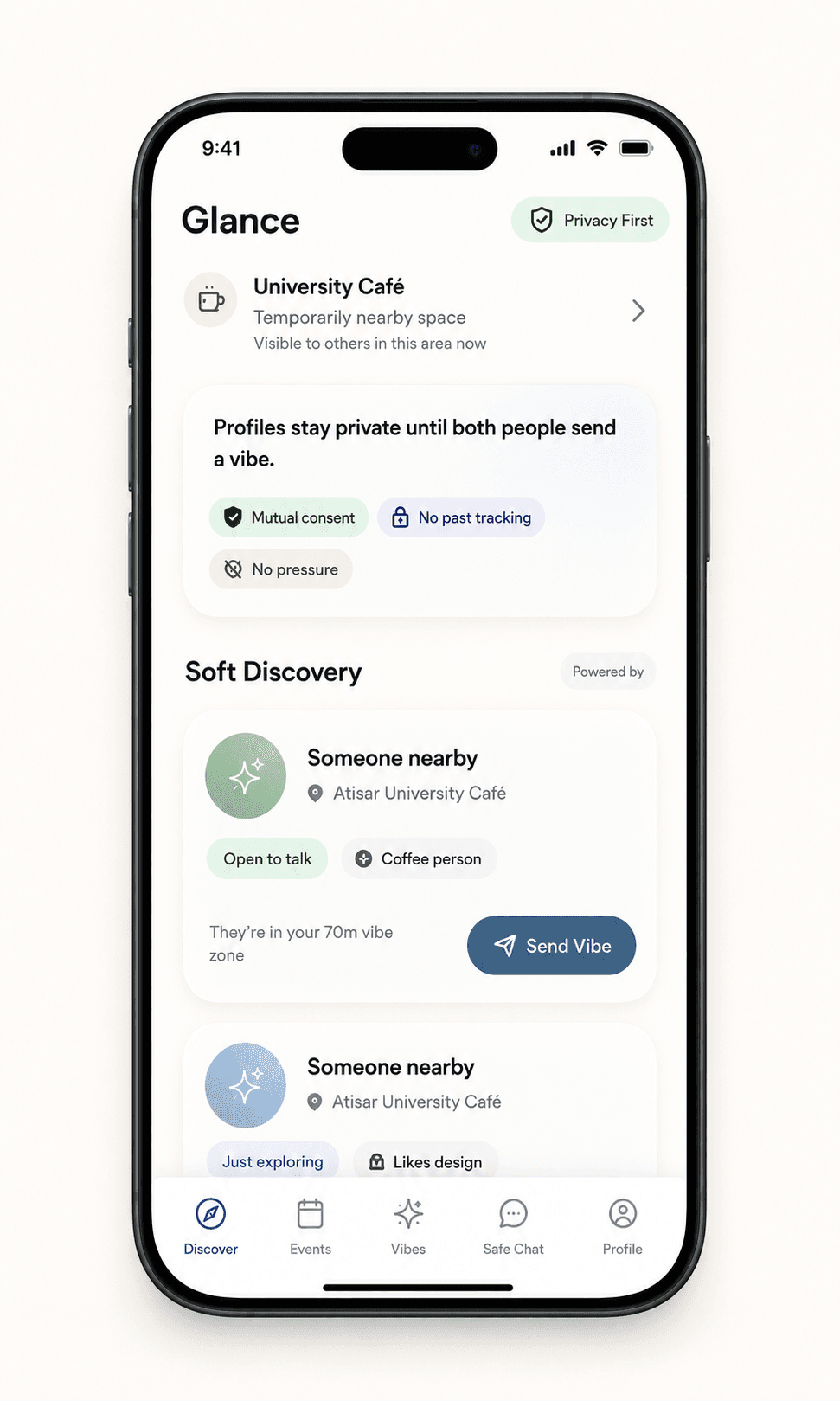
Privacy-First Soft Discovery
Design B
Anonymous vibes, hidden identity, safety controls surfaced first.
Out of 15 respondents
Which design feels safer to use?
Which design feels easier to understand?
Which design feels less creepy or uncomfortable?
Which design would you personally prefer to use?
Interest is real. Trust still has to be earned.
Open-ended responses were manually coded into themes. Privacy and design clarity dominate, tied at the top — confirming that adoption depends on privacy, safety, usability and verification, not just the novelty of the idea.
Coded mentions across open feedback
Adoption Intention
Privacy & safety
“Sharing my location” and misuse/harassment risk were named directly — a strong signal that safety must be architectural, not a small feature.
Value of mutual consent
Respondents said two-sided interest “helps users feel more comfortable and protects their privacy.”
Need for verification
Multiple comments asked for verified or confirmed real users — anonymity helps comfort, but too much of it erodes trust.
Three tensions that had to shape the design.
Glance can't become just another dating app or a nearby profile browser. Its position is a soft, temporary, consent-based layer between noticing someone in real life and starting a digital conversation — and that position only holds if these three tensions are resolved deliberately.
Visibility vs. Privacy
Users want to recognize people, but they don't want full exposure or tracking.
Anonymity vs. Trust
Anonymous vibes reduce rejection fear, but users still need protection from fake profiles and misuse.
Simplicity vs. Safety Explanation
A direct interface is easier to understand, but a privacy-first interface feels safer.
From evidence to a privacy-first product decision.
First Version Includes
Not Prioritized Yet
Build the MVP around trust
Anonymous vibes, mutual unlock, privacy explanation, hide mode, block/report, no past-location tracking.
Use Design B as the base
Foundation on the privacy-first interface, then borrow Design A's clearer discovery cues.
Add verification before scaling
Balance anonymity with trust through student email, phone, or optional verification.
Prototype-test the real journey
5–8 participants: discover, send a vibe, understand mutual unlock, find safety controls.
Glance has early evidence of
problem-solution fit.
Users showed real interest in the concept, but acceptance depends on visible privacy, mutual consent, safety controls, profile verification, and simple communication. The research supports building Glance as a privacy-first, emotionally aware social-discovery platform — one that turns a public glance into a safe digital signal.
Read this research honestly
Small sample — only 15 respondents, treated as early-stage evidence, not final market proof.
Mostly university students — the first target segment, but not the full future audience.
Measures intention, not behaviour — real usage in public may differ from stated intent.
Static A/B images, not an interactive prototype — users may respond differently once they can navigate the app.